 Jökulsárlón Glacier Lagoon Boat Tours
Jökulsárlón Weather by Month
Jökulsárlón weather decides whether the boats sail, whether Route 1 stays open and how many layers you need on the shore. This page gives the monthly climate table for the nearest station, wind and rain figures, daylight hours, the boat, Zodiac and kayak seasons, and the cancellation rules the operators use. For the boats themselves, see the full comparison of Jökulsárlón glacier lagoon boat tours on the Jökulsárlón glacier lagoon boat tour.
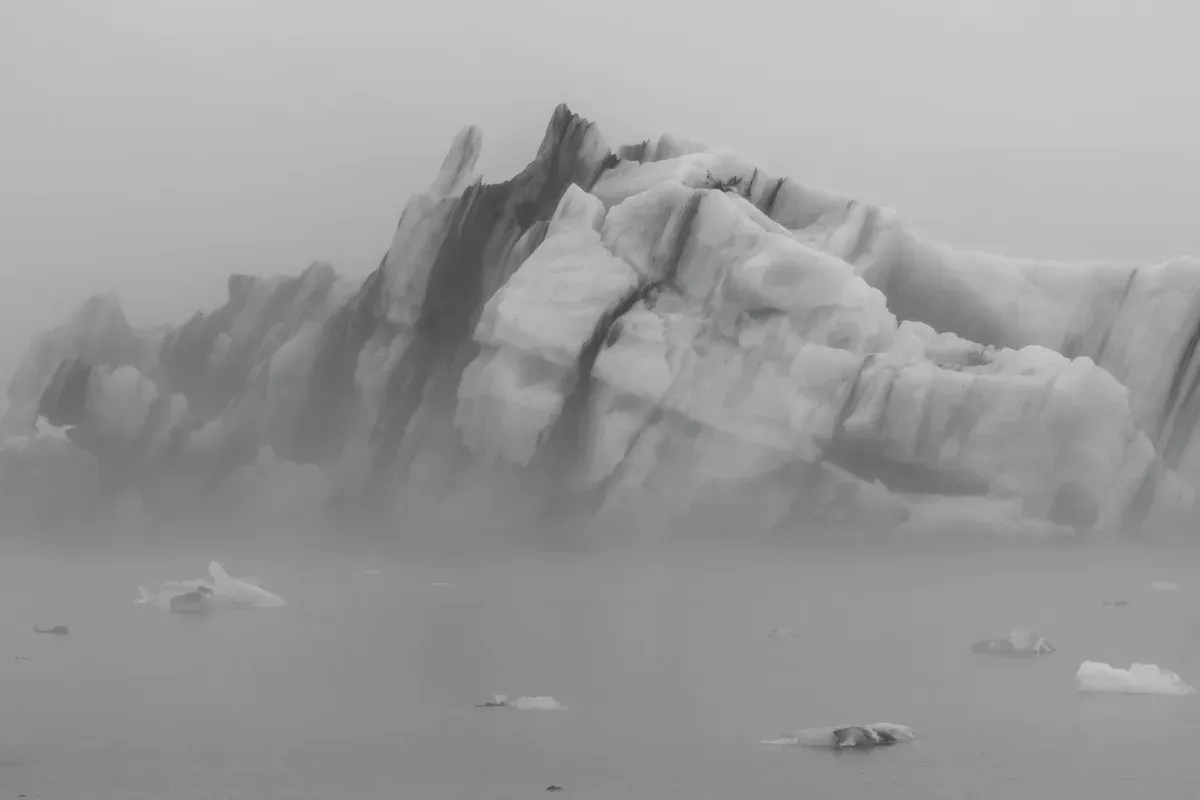
A large iceberg looms in fog on the lagoon. Photo: Tim Sackton, CC BY-SA 2.0, via Wikimedia Commons
Quick answer Weather in short
Jökulsárlón weather is mild for the latitude: July averages about 12.6 degrees Celsius high and January about 2.5 high, with 164.2 mm of rain in January at the nearest station. The amphibian boats run May to November, the Zodiac May to October and kayaks mid May to September. Winter brings no boats at all, short days and the chance of road closures on Route 1.
Key takeaways
- See how the seasons, prices and boats compare in the full guide to Jökulsárlón glacier lagoon boat tours.
- Boats in season: the amphibian ride and the Zodiac each have their own guide, see the amphibian boat tour and Zodiac boat tour pages.
- In winter, check the dates of the ice floating trip on Fjallsárlón or take a day trip by coach, weather permitting.
- Check what each tour includes in the comparison table before you book, because the optional boat rides cost extra on some day trips.
Jökulsárlón Weather by Month
The figures below come from the Höfn station of the Icelandic Met Office, 1961 to 1990 averages, about 80 kilometres east of the lagoon. It is the nearest station with a published table in the sources.
Monthly Climate Table
Höfn sits on the same south-east coast as Jökulsárlón, so its numbers are the best available proxy for the lagoon itself. The table lists the mean daily high, the mean daily low, total precipitation and the number of days with measurable precipitation for every month. The figures are Met Office normals for 1961 to 1990 published for the Höfn station.
Note that no monthly temperature averages for the lagoon itself exist in a verified source, so treat these as coastal south-east Iceland values rather than shore-side readings.
| Month | High | Low | Rain | Rain days |
|---|---|---|---|---|
| January | 2.5 °C | -2.5 °C | 164.2 mm | 17.1 |
| February | 2.9 °C | -2.0 °C | 130.2 mm | 14.1 |
| March | 3.5 °C | -1.8 °C | 121.2 mm | 15.5 |
| April | 5.7 °C | 0.3 °C | 94.8 mm | 12.9 |
| May | 8.5 °C | 3.2 °C | 95.7 mm | 12.7 |
| June | 11.0 °C | 6.1 °C | 88.8 mm | 13.8 |
| July | 12.6 °C | 7.7 °C | 84.4 mm | 14.9 |
| August | 12.2 °C | 7.3 °C | 110.7 mm | 15.4 |
| September | 9.9 °C | 4.7 °C | 119.0 mm | 15.3 |
| October | 7.0 °C | 2.2 °C | 183.1 mm | 17.3 |
| November | 3.7 °C | -1.2 °C | 116.8 mm | 14.0 |
| December | 2.7 °C | -2.7 °C | 145.9 mm | 16.1 |
What the Table Means for a Boat Trip
Even the warmest month at the nearest station has a mean daily high of only 12.6 degrees Celsius, so a boat ride is never a warm-weather activity. July is the driest month at 84.4 mm and August is the rainiest summer month at 110.7 mm, yet October is the wettest month of the year at 183.1 mm across 17.3 rain days. That matters because the amphibian season runs to mid November and the Zodiac season to the end of October, so the wettest month overlaps both.
Wind is the bigger factor than temperature: WeatherSpark puts average wind at Höfn at 31.3 km/h in January, easing to about 17 km/h in July. The record extremes at Höfn run from 24.4 degrees in August down to -21.6 degrees in March, so a summer day can still be cold on the water and a spring day can still freeze. For day trips from Reykjavík, the coach ride is about 370 kilometres each way, roughly 4.5 hours of driving, so road weather matters as much as lagoon weather.
- July and August have the calmest average wind, about 17 to 18.6 km/h.
- October has the most rain, 183.1 mm, and falls inside both boat seasons.
- May is the clearest month, with 42 percent of the time clear or partly cloudy.
What to Wear by Season
The ground at the lagoon is slippery, and sturdy waterproof boots are the standard advice in every season. In summer, bring warm base layers, a fleece, a waterproof jacket, hat, gloves, sunglasses and closed toe shoes, which is the same list a reseller gives for the open Zodiac. Zodiac passengers get flotation suits and life jackets provided, and kayak guests get a drysuit and life vest.
In winter, ice cleats and layered clothing are recommended for night visits to the lagoon, because January wind of 31.3 km/h makes wind chill matter more than the air temperature. From June to August there is no snowfall at Höfn, but June to August still have 13.8 to 15.4 rain days a month, so a waterproof outer layer stays in the bag all year.
Sources: Vatnajökull National Park, prices, Jökulsárlón
When Weather Stops the Boats
Three different craft operate on the lagoon and each has its own season and its own weather limits.
Seasons for Each Boat
The amphibian boats sail from May to November, with hours running 10:00 to 17:00 in May, 09:00 to 19:00 from June to September and 10:00 to 17:00 from October to 15 November. The tour lasts 30 to 40 minutes and costs 7,100 ISK for adults aged 13 and over, about $58 at roughly 122 ISK to the US dollar, with children 6 to 12 at 3,500 ISK (about $29) and under 6 free. The Zodiac season is May to October, the ride lasts 1 hour 15 minutes and costs 16,600 ISK for adults, about $136, and 8,300 ISK for children 10 to 12, about $68.
Children must be at least 10 years old or 130 centimetres tall. Kayaking runs roughly mid May to September, with a minimum age of 14 and about 1 to 1.5 hours of paddling plus 30 minutes of briefing. Full details of the motor boats are on the Jökulsárlón amphibian boat tour and Jökulsárlón Zodiac boat tour pages, each with one page of its own.
Wind, Waves and Cancellations
The operator states plainly that weather can affect Zodiac availability, and the Zodiac goes almost all the way up to the Breiðamerkurjökull glacier wall when conditions allow. Storms on this coast are serious: past reports put expected winds at 45 m/s on the Route 1 stretch through Skeiðarársandur and Öræfi, gusts of 50 m/s have been recorded in the south-east, and in one 2018 warning the Road Administration expected 35 m/s near Skeiðarársandur with sand storms. In a 2018 storm the road from Skeiðarársandur to Jökulsárlón was closed, and in a 2019 storm Route 1 was closed.
Recorded weather cancellations at the lagoon were 2.7 percent in February, 0.4 percent in April and 0 percent in July and August, which shows how the risk sits in winter rather than summer. The amphibian operator's rule is clear: if a tour is cancelled for safety reasons you can rebook or get a full refund. Arctic Adventures says it may adjust the itinerary or take different routes when conditions are dangerous.
| Boat | Season | Duration | Adult price |
|---|---|---|---|
| Amphibian | May to November | 30-40 minutes | 7,100 ISK (about $58) |
| Zodiac | May to October | 1 hour 15 minutes | 16,600 ISK (about $136) |
| Kayak | roughly mid May to September | 1-1.5 hours paddling | not stated |
Booking Rules That Protect You
Because weather is the one variable you cannot control, the cancellation terms matter. On the amphibian tour, a full refund applies if you cancel 24 hours or more before departure, and a 50 percent refund applies from 23 hours until 2 hours before. A safety cancellation by the operator always allows a rebook or a full refund.
Every one of the day trips on this site also offers free cancellation up to 24 hours before, so a weather-spoiled day does not have to cost money. The Zodiac has limited seats and the operator recommends booking in advance online, which cuts both ways in bad weather: book early, but watch the forecast. Zodiac check-in is 30 minutes before departure, and one reseller puts total Zodiac time at about 2 hours including check-in and the truck transfer from the main parking area.
Daylight and Northern Lights
Daylight swings more than temperature does at this latitude, and it shapes what you can actually do in a day.
Daylight Hours by Month
WeatherSpark gives monthly daylight for Höfn, and Iceland stays on GMT all year with no daylight saving change. June has up to 21 hours of daylight and December about 4, which is the headline. In practice the shortest day is 21 December with 4 hours 3 minutes and the longest is 21 June with 21 hours 15 minutes.
Winter visitors should plan about 2 hours at the lagoon and 1 to 2 extra hours for Diamond Beach inside those short days. Crowds peak at midday, so an early or late stop in summer uses the long light and avoids the busiest hours.
| Month | Daylight |
|---|---|
| January | 5.5 hours |
| February | 8.6 hours |
| March | 11.9 hours |
| April | 15.3 hours |
| May | 18.6 hours |
| June | 21.0 hours |
| July | 19.5 hours |
| August | 16.2 hours |
| September | 12.9 hours |
| October | 9.6 hours |
| November | 6.4 hours |
| December | 4.3 hours |
Northern Lights Season
The northern lights are best seen at Jökulsárlón from late September to mid April, with peak months from October to March and the season running late September to early April. The best viewing window is between 10 PM and 1 AM, and a KP index of 4 or higher helps while a full moon washes out the sky. The Icelandic Met Office publishes cloud cover and aurora forecasts for exactly this purpose.
Three viewing spots are the lagoon shore, the Route 1 bridge area and Diamond Beach. Keep well back from iceberg edges, because icebergs can shift suddenly, and at Diamond Beach stay at least 30 metres from the water and never turn your back on the ocean. Bring ice cleats and layered clothing for a night visit.
Crowds Through the Year
August is the busiest month at the lagoon, with about 2,330 vehicles a day on the nearby counter, and July sees about 2,225. April is the quiet balance point at about 1,165 vehicles a day and is recommended for combining ice, access and fewer crowds. High seasons are June to August and November to January, so the two crowd peaks coincide with the best boat weather and the best aurora months respectively.
Most visitors stay within 100 metres of the parking lot, so walking further along the shore finds quieter corners even in August. A coach day trip such as the Glacier Lagoon Boat Ride Day Trip gives you 1 hour at the lagoon and 30 minutes at Diamond Beach, while the South Coast and Jökulsárlón Day Tour allows 1.5 hours at the lagoon with the boat as an optional extra.
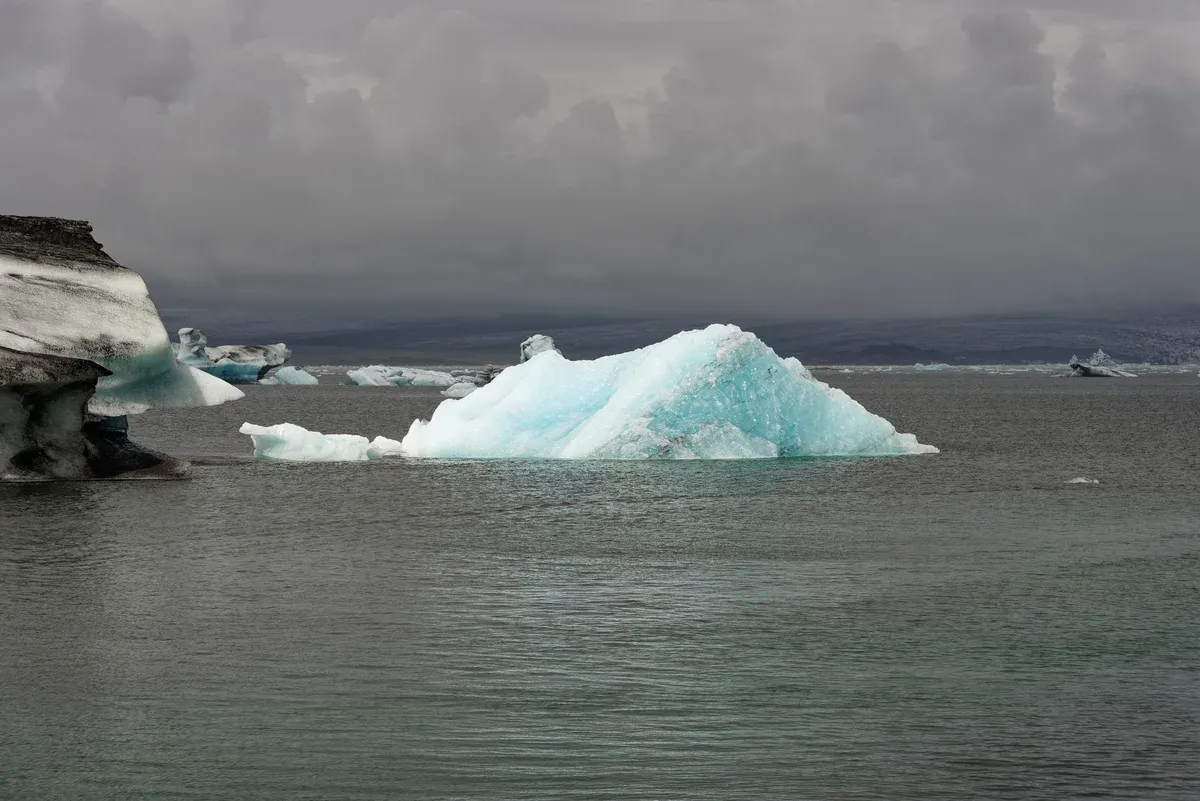
A blue iceberg floats under a grey sky on the lagoon. Photo: Jakub Hałun, CC BY 4.0, via Wikimedia Commons
The Road in Bad Weather
Most visitors reach the lagoon on Route 1, and the road is the part of the trip that winter weather can close.
Route 1 in Winter
Route 1 runs 1,309 kilometres around the country and has the highest priority for snow removal, serviced seven days a week in winter. That priority does not make it storm proof: Route 1 was closed and domestic flights cancelled in a 2019 storm, and the Skeiðarársandur to Jökulsárlón stretch shut in a 2018 storm. The drive from Reykjavík takes about five hours direct, and 7 to 8 hours with South Coast stops.
The Kirkjubæjarklaustur to Höfn stretch is about 205 kilometres with fuel limited to Freysnes and Fagurholsmýri, so fill up before the emptiest part. In winter, four wheel drive gives better traction and closures are possible. Weather in Iceland can change fast, and sudden changes can sharply cut visibility and raise wind speed and precipitation.
Where to Check Conditions
Road conditions are published on umferdin.is, and the traffic service answers on phone 1777. Safetravel.is is run by ICE-SAR, the Icelandic Association for Search and Rescue, and shows road status, wind gusts at Öræfi and Skeiðarársandur, sand storms and closures using a colour-coded system and an interactive map. The Icelandic Met Office offers station forecasts for the whole country, text forecasts, meteograms and marine forecasts, and a spoken weather service on +354 902 0600.
SafeTravel recommends sharing a travel plan with a trusted person, and the Safetravel app lets you share GPS coordinates with emergency services. If anything goes wrong, the emergency number in Iceland is 112, and the backup number 599 0112 exists because of the 2G and 3G shutdown. For coach travellers, a closed Route 1 can still change a day tour, so check the same sources before you set out.
Winter Alternatives When Boats Are Gone
Boat tours do not run on the lagoon in winter, so a cold-season visit is a shore visit. Ice cave tours leave from Jökulsárlón Glacier Lagoon and one listing runs October to April, with helmets and crampons supplied by guides. Ice caves are weather dependent, open only in freezing conditions without rain, and are confirmed the day before, and February is called the safest ice cave month.
On neighbouring Fjallsárlón, ice floating in an immersion suit is a bookable trip at $125.88 per person for 1.5 hours. The listing does not state its season and marks it as cancelled in bad weather, so check the dates before you plan around it.
Weather Tips for Jökulsárlón
Five habits that make a weather-affected day work, and four mistakes that ruin one.
Do
- Do check umferdin.is and phone 1777 for road conditions before driving, because Route 1 closures have closed the Skeiðarársandur to Jökulsárlón stretch in past storms.
- Do book a boat with free cancellation up to 24 hours, because the amphibian operator refunds in full only from 24 hours out and at 50 percent from 23 hours to 2 hours before.
- Do bring waterproof boots and layered clothing in every season, because the ground is slippery and even July has a mean daily high of only 12.6 degrees Celsius.
- Do plan a winter visit around about 4 hours of December daylight, allowing 2 hours at the lagoon and 1 to 2 extra hours for Diamond Beach.
- Do share a travel plan with a trusted person through SafeTravel, because weather in Iceland can change fast and the app shares GPS coordinates with emergency services.
Don't
- Don't expect boats between November and May, because the amphibian season ends in November, the Zodiac ends in October and kayaking runs only mid May to September.
- Don't get close to the lagoon edge or step on icebergs, because icebergs can shift suddenly, flip, and waves can rush ashore.
- Don't turn your back on the ocean at Diamond Beach, because the standard advice is to stay at least 30 metres from the water.
- Don't chase the aurora on a full-moon night or in low KP, because a KP index of 4 or higher helps and a full moon washes out the sky.
Jökulsárlón Weather Questions
What is the best month for weather at Jökulsárlón?
July has the warmest average high at 12.6 degrees Celsius, the least rain at 84.4 mm and the calmest wind at about 17 km/h, plus zero recorded weather cancellations. August is nearly as good but busiest, with about 2,330 vehicles a day, so many travellers prefer the balance of April as the season guide explains.
Do the boats run in winter at Jökulsárlón?
No, boat tours are not available in winter, the amphibian season runs May to November, the Zodiac May to October and kayaking mid May to September. Winter visitors see the lagoon from the shore, and the season detail is on the homepage under when the boats run.
How cold does it get at Jökulsárlón?
At the Höfn station, about 80 km east of the lagoon, the January mean high is 2.5 degrees Celsius and the mean low -2.5, with a record low of -21.6 degrees in March. Wind of 31.3 km/h in January makes wind chill matter more than the air temperature, so pack for the wind as much as the cold.
Can bad weather cancel a boat tour?
Yes, the operator says weather can affect Zodiac availability, and safety cancellations allow a full rebook or refund on the amphibian tour. Recorded weather cancellations were 2.7 percent in February and 0 percent in July and August, so a summer booking carries very little risk, and every day trip from Reykjavík offers free cancellation up to 24 hours before.
When can I see the northern lights at Jökulsárlón?
The season runs late September to early April, with peak months October to March and the best window between 10 PM and 1 AM. A KP index of 4 or higher helps and a full moon washes out the sky, and the Met Office publishes a cloud cover and aurora forecast for planning.
Is Route 1 to Jökulsárlón open in winter?
Usually yes, because Route 1 has the highest priority for snow removal and is serviced seven days a week in winter, but storms have closed it before. Check conditions on umferdin.is or call 1777, and read more in the bad weather road section.